
Life happens...Maybe you won the trophy but lost your four front teeth in last weekend’s polo tournament? Or maybe you would like to say farewell to a removable denture and get something more solid? We specialise in restoring your smile by offering solutions to suit your needs and your pocket.
Dental Implants have revolutionised the world of reconstructive dentistry. We see firsthand the transformation of lives when we incorporate dental implants into our treatment plans. Our Implants allow us to build solid foundations, whether replacing a single tooth in a smile or reconstructing a complete complement of teeth. The design is continuously evolving, materials are improving and new treatment methods are being devised.
AND CDE Durbanville are at the forefront of it all and is proud to offer you the best from the world of implant dentistry.
Contrary to belief, receiving a dental implant need not be painful or traumatic. We know that experience is as much about the physical procedure as it is about the mental process. We prepare you for both. This is why we allow you to relax with a cup of tea before we apply the anaesthetic and allow time for it to work. Dr Lara or Dr Heinrich will then perform the procedure which takes between 10 and 20 minutes depending on each case. We place your implant with precision and then apply a healing cap into position. A radiograph (x-ray) is taken to confirm the position of the dental implant.
Apart from slight discomfort for a day, 9/10 patients report no pain following the procedure. We will then set up a second appointment in the next 12 weeks for the manufacturing of the final implant crown.
Now that your implant is integrated and solid, we may make the perfect crown. Again, Dr Lara or Dr Heinrich will once again anaesthetise the area and allow time for it to work properly. We will then place your implant abutment, which connects the implant body to the crown portion. Once in place and confirmed, a scan will be taken using the latest intra-oral scanner from Sirona®. This allows them to create a 3D digital model on a computer where the design process starts.
By the time your crown has been milled and hits the oven at 840°C, you will be enjoying your second cup of coffee whilst catching up on your favourite Netflix. Once this is complete, your crown will be placed and your bite will be checked to make sure that it is accurate. We recommend that your dental implants should be examined every 6 months.
For more information about Dental Implants in Durbanville, or to schedule a consultation, contact The Cosmetic and Dental Emporium Durbanville at 021 914 1033.
If you have missing teeth and want a permanent, natural-looking solution, dental implants may be an ideal option. Our Durbanville dentists provide comprehensive assessments to determine your suitability for treatment.
Book a consultation today to explore your options for restoring your smile with a long-term tooth replacement solution.
Dental implants are a popular way to replace missing teeth, but not everyone is ready for them right away. Good candidates usually have one or more missing teeth, healthy gums, good overall oral health, and enough jawbone to support an implant. If there’s significant bone loss from missing teeth or gum disease, bone grafting may be needed first.
Healthy gums are essential because gum disease can lead to implant failure through infection or bone loss. Smoking can also lower the success rate by slowing healing and affecting how the bone integrates with the implant. Smokers can still get implants, but quitting or cutting back improves results.
Medical conditions like diabetes, osteoporosis, or autoimmune disorders can impact healing, so it’s important to discuss your health history with your dentist.
Age isn’t usually a barrier for adults, though implants aren’t recommended for anyone under 18 whose jawbones are still developing.
If implants aren’t suitable, other options include dental bridges, which use nearby teeth for support, or removable dentures as a non-surgical way to replace multiple teeth.
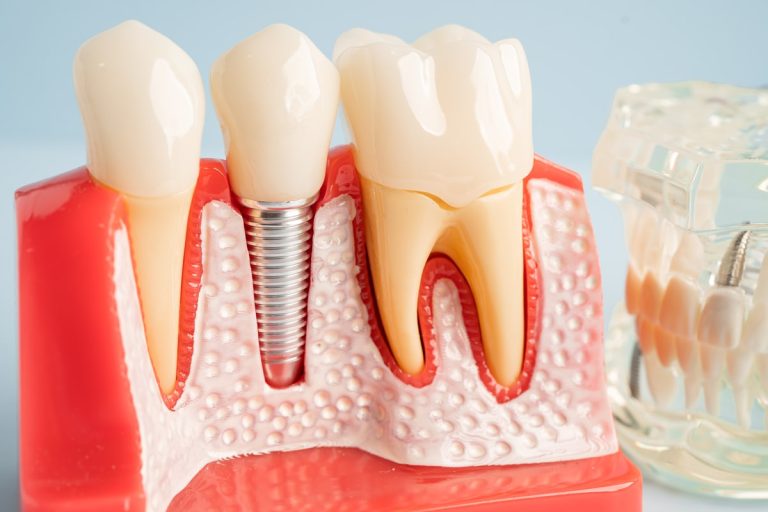
The dental implant procedure is a multi-step process that involves careful planning, surgery, and healing time to ensure a long-lasting and natural-looking result. Below is a step-by-step guide to what patients can expect.
The first step is a thorough examination by the dentist to determine whether a patient is a suitable candidate for dental implants. This includes:
If bone loss is detected, bone grafting or a sinus lift may be recommended before proceeding with implant placement.
Once the patient is approved for the procedure, a customised treatment plan is created. This includes:
On the day of surgery, the implant is placed into the jawbone under local anaesthesia or sedation for comfort. The steps include:
The procedure is typically completed in one to two hours per implant, and most patients experience minimal discomfort afterward.
After implant placement, the jawbone gradually fuses with the titanium post in a process called osseointegration. This typically takes between three to six months and is crucial for ensuring a strong and stable foundation.
During this period, a temporary crown or denture may be provided to maintain aesthetics and function. Patients are advised to follow aftercare instructions carefully to support healing.
Once the implant has fully integrated with the bone, a small abutment is attached to the implant. This serves as a connector between the implant and the final custom-made crown.
The dentist then takes impressions to design a crown that matches the patient’s natural teeth in size, shape, and colour. Once ready, the crown is securely attached, completing the restoration.
The final step involves:
The total cost of teeth implants depends on:
While prices vary from one practice to another, general cost estimates in South Africa are:
These estimates may change based on individual cases, additional treatments, and clinic pricing structures.
Proper aftercare is essential for ensuring the success and longevity. While the healing process varies from person to person, following the right care routine can help prevent complications and support long-term oral health.
The healing process occurs in stages:
Maintaining good oral hygiene is crucial for preventing infections and ensuring implant success.
If pain, swelling, or bleeding worsens, contact the dentist immediately.
Once fully healed, implants should be cared for like natural teeth to ensure their longevity.
Dental implants are artificial tooth roots made of titanium that are surgically placed into the jawbone. Over time, they fuse with the bone in a process called osseointegration, creating a strong foundation for a dental crown, bridge, or denture. This makes implants a durable and natural-looking replacement for missing teeth.
With proper care, the implant itself can last a lifetime. The attached dental crown may need replacement after 10 to 15 years due to normal wear. Regular brushing, flossing, and dental check-ups help extend the lifespan of both the implant and the crown.
The procedure is performed under local anaesthesia or sedation, so patients do not feel pain during surgery. Some mild discomfort, swelling, or bruising may occur after the procedure, but this typically subsides within a few days and can be managed with pain relievers.
Dental implants have a success rate of over 95% when placed by an experienced dentist and properly maintained. Factors such as good oral hygiene, not smoking, and overall health contribute to long-term success.
The cost varies depending on factors such as the number of implants, bone grafting needs, and the type of crown used. In South Africa, a single dental implant typically costs R15,000 to R25,000. Full-mouth implants or All-on-4 solutions can range from R150,000 to R250,000 per jaw. A consultation is necessary to determine the exact cost for your specific case.
The initial healing period takes one to two weeks, but full recovery, including osseointegration (bone fusion), can take three to six months. Once the implant has fused with the bone, the final crown or prosthetic is placed.
Most adults with good oral health and sufficient jawbone density can receive dental implants. However, some conditions may require additional treatment before implant placement, such as bone grafting for those with bone loss. Patients with uncontrolled diabetes, severe gum disease, or heavy smoking habits may need further evaluation to determine eligibility.
While complications are rare, potential risks include:
Choosing an experienced implant dentist and following proper aftercare instructions significantly reduces these risks.
Dental implants require regular brushing and flossing, just like natural teeth. Other care tips include:
If dental implants are not a suitable option, alternative treatments include:
Most medical aids in South Africa do not fully cover dental implants, as they are often classified as a cosmetic procedure. However, some plans may provide partial coverage for consultations, X-rays, or related treatments. Patients should check with their provider to determine eligibility for reimbursement.
While low-cost implants may seem appealing, it is essential to consider:
Choosing an experienced professional ensures a successful procedure and reduces the risk of complications.
"*" indicates required fields
Copyright © 2024 The Cosmetic and Dental Emporium | All Rights Reserved